
LayerOrder Fieldbook Logo
LayerOrderFieldbook
Independent Laser Fieldbook Execution Sequence

Understand the Order Behind Every Laser Job

Explore layer sequencing, operation priorities, travel paths, and pre-run questions through independent laser workflow cases. LayerOrder Fieldbook helps readers understand how a planned sequence relates to the final job.

JOB / SEQUENCE 02

Every step changes the path. Inner contours first, surface marking before severance.

Featured Operational Guide
Software
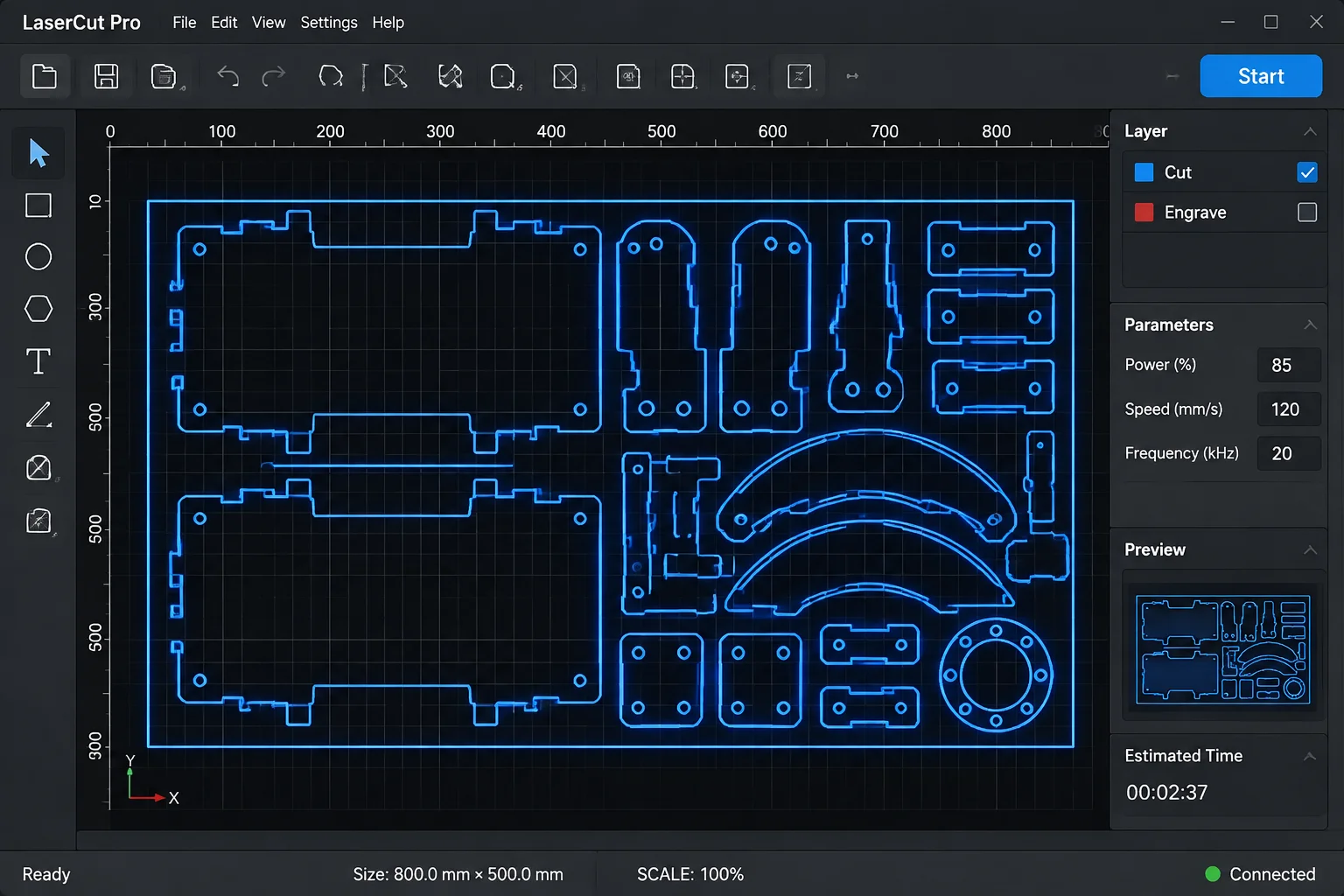
Creating an Operation Order Sheet

Creating an Operation Order Sheet

Systematic worksheet setup defining laser speeds, power hierarchy, raster scans, and cut execution flow prior to sending code to the bed.

2026-10-20 Workflow Expert
Consult guide
Foundational Glossary

Dictionary for Beginners

Core laser cutting vocabulary simplified into concise, one-sentence explanations to help operators configure workflows properly before pressing start.

Vector Setup

Layer

A design workspace tag that groups geometry together and assigns a shared set of speed, power, and operational behaviors.

Operational Role
Execution Path

Cut Order

The predetermined numerical sequence that dictates the exact order in which vectors, shapes, and layers are executed by the machine.

Sequence Logic
Motion Study

Travel Move

A rapid non-cutting positioning trajectory where the laser head traverses between geometries while the beam remains switched off.

Non-Cutting Rapid
Tolerance

Kerf

The physical thickness of workpiece material burned away during cutting that must be offset for tight mating joints.

Width Compensation
Structure

Inner-First Rule

The essential practice of cutting interior holes before exterior boundaries so material support stays flat and unshifted.

Stability Priority
Pre-Flight

Simulation Preview

A real-time software animation verifying cut paths, total cycle time, and potential collisions before running physical equipment.

Virtual Validation

Explore Complete Technical Principles

Deep-dive into multi-part nests, travel path optimization, and operational checklists.

Browse Knowledge Base
Operational Inquiries

Direct Clarifications on Sequence Planning

Laser operators and workshop leads frequently question the necessity of structured layer hierarchies. Here is why controlled execution sequence protects workshop margins, machine integrity, and production schedules.

Cost Factor

Does sequencing add unnecessary setup overhead?

Default software auto-sort optimizes solely for head travel distance, ignoring part detachment. A brief forty-second sequence check eliminates dropped parts, head strikes, and costly ruined stock.

Measured OutcomeNear-zero scrap from dropped cutouts
Production Deadlines

Will manual job sorting delay rush projects?

A job aborted halfway through because an outer perimeter detached before engraving destroys the entire schedule. Standardized layer presets accelerate throughput by guaranteeing successful first-pass runs.

Measured OutcomeConsistent first-pass cycle times
Workflow Complexity

Is order hierarchy too difficult for junior staff?

The hierarchy follows a strict universal rule: inner features first, surface markings second, perimeter cuts last. Documenting this in operation sheets removes guesswork and standardizes shift training.

Measured OutcomePredictable operator onboarding
Technical Reference

What technical guidance handles edge cases?

Complex nested geometry and grouped vector objects can alter execution unexpectedly. Our structured handbook provides explicit verification checklists before firing the laser head.

Measured OutcomeDocumented pre-flight protocols

Need in-depth documentation on fabrication principles and team training?

Read About LayerOrder
Virtual Inspection Tour

Interactive Operation Sequence Simulator

Explore how the planned sequence executes on the bed. Switch views to inspect non-cutting travel trajectories, internal drop clearances, and outer release order before running physical materials.

Select Operation Stage
Stage 1 of 3: Surface Vector Marking
Est. Time: 01m 18s Travel: 420 mm
Marking and vector etching preview
Verification Rule: Workpiece clamping remains 100% stable; beam speed prioritized over focal depth.
Beam Focus State
Surface (+0.0 mm)
Bed Displacement Risk
0.0% (Zero Kerf Cut)
Assist Gas Volume
Low / Shielding Only
Workflow Efficiency Matrix

Production Cost & Cycle Impact Estimator

Sequence planning dictates operational overhead. Select an operational configuration below to inspect calculated machine runtime, rework exposure, and unit manufacturing costs.

Select Planning Preset:

Calculated Benchmarks
Estimations are calibrated across a standard 100-part nesting job on 3mm cast acrylic and 4mm birch sheets at 80W laser beam equivalent.
Standard Batch Scenario

Unplanned Arbitrary Setup

Cost / 100 Units: $44.80
Job Runtime
14.2 min +145% idle travel overhead
Scrap Probability
38.5% Shift on dropped parts
Uncut Traverse Path
142.4 m Heavy mechanical axis wear
Sequence Risk Breakdown

Cut Before Engrave Failure

The external perimeter falls through the support grid before inner details and vector marking are engraved, leading to out-of-focus optics and spoiled parts.

Need verification on your production layer structure?
Request Workflow Audit
Operational Fieldbook

Latest Knowledge Base Articles

Essential principles, structural checklists, and layer priority mechanics compiled for workshop operators and laser fabrication teams.

Marking Before Cutting
Education2026-09-08Edu Team

Marking Before Cutting

Preserving workpiece position and dimensional accuracy by executing all surface marks prior to vector outline separation.

Benchmarked Field Hardware

2026 Laser System Reviews & Sequence Tests

Hardware evaluations focused strictly on head acceleration, firmware-level layer grouping, and mechanical path reliability during multi-pass manufacturing runs.