
Sequence 01
2026-09-08
Marking Before Cutting
Why surface labeling and score passes must strictly precede structural perimeter severance.
Read articleExecuting cut files without defining layer precedence leads directly to premature part detachment, charred surfaces, head collisions, and scrap stock across multi-step laser production runs.
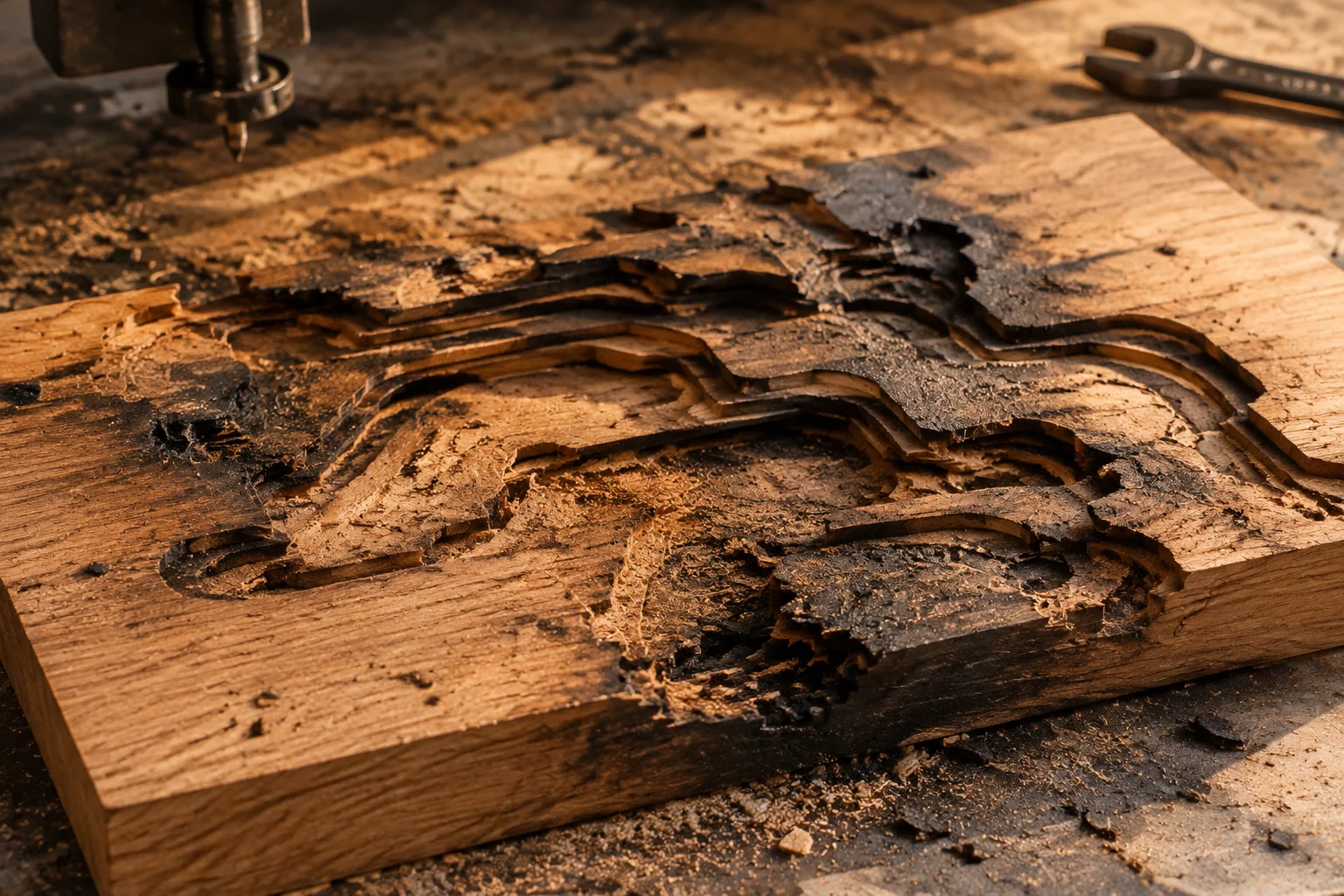
Laser controllers read layers sequentially from top to bottom unless strict path rules override them. Leaving cutting operations before engraving or vector scoring causes localized focal shifts, smoke contamination over finished artwork, and physical shifts as unsupported items drop below the honeycomb bed plane.
When an operator loads vector artwork without auditing layer hierarchy, the machine defaults to whichever layer was created first or arbitrarily assigned in CAD. If that initial layer happens to sever outer boundaries, structural tension is lost instantly. The component loosens inside the sheet, tilts into the honeycomb grid, or shifts under the air-assist jet before secondary internal features or fine engravings are applied.
Thermal accumulation represents an equally severe risk. Cutting dense perimeters generates intense smoke deposits and airborne sap condensation. Performing shallow vector marking or bitmap rastering after heavy cutting forces the laser head across soot-coated surfaces, leading to blurred details, contaminated optics, and unpredictable char marks across delicate materials.
Layer color is meaningless to the laser tube itself; order of execution dictates everything. Adhering to predictable workflow standards guarantees pristine surface finishes and keeps mechanical components seated securely through heavy vector burns.
Connect with our technical educators for tailored layer template guidance, material priority presets, or assistance debugging unusual toolpath behavior in production files.
Why surface labeling and score passes must strictly precede structural perimeter severance.
Read articleHow geometry grouping overrides layer-wide priority and alters motion paths between segments.
Read articleSecuring mechanical stability by piercing internal contours while stock remains anchored.
Read articleA concise 5-point physical verification protocol before enabling laser discharge.
Read article