
Sequence 01
2026-09-08
Marking Before Cutting
Why surface labeling and score passes must strictly precede structural perimeter severance.
Read articleAnalyzing non-cutting traversal vectors in preview software reveals hidden transit bottlenecks, collision liabilities, and inefficient cutting sequences before machine execution.
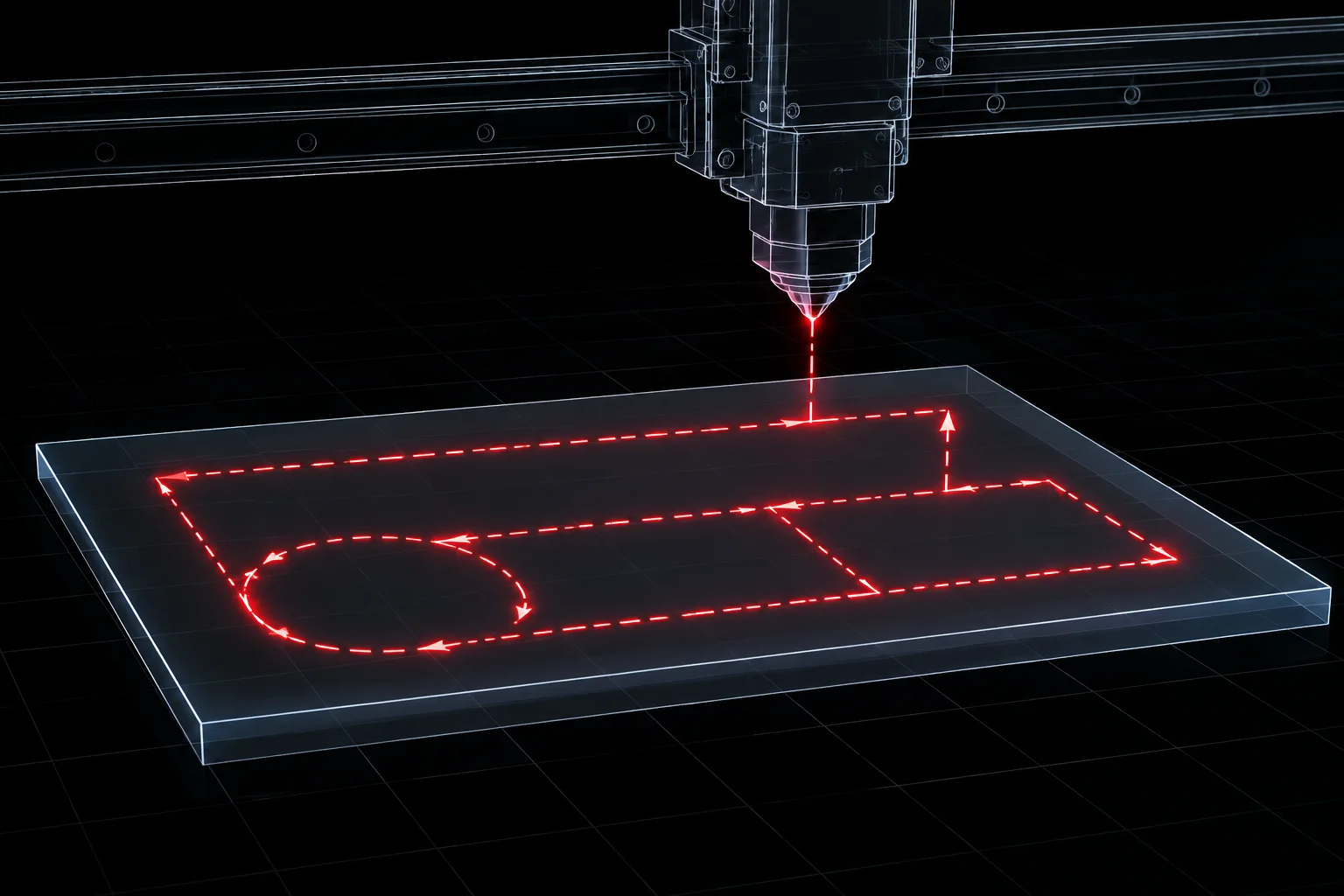
Laser software previews render non-cutting head repositioning as dashed or solid colored traversal vectors. Analyzing these rapid paths allows operators to pinpoint unnecessary traversals across previously cut components, prevent air assist nozzle snags on tipped scrap, and slash cycle duration.
During laser machining, the motion gantry alternates between powered cutting or engraving passes (feed moves) and unpowered carriage repositioning (G00 rapid travel). While active toolpaths transform the stock material, travel moves represent pure operational overhead and potential collision exposure.
In preview simulations, red dashed lines depict the gantry traveling at maximum velocity with the laser discharge turned off. Inspecting this spatial geometry validates whether the motion controller executes logical clustering or drags the carriage back and forth across disconnected quadrants of the bed. High density in transit vectors signifies erratic layer hierarchy or disjointed vector paths.
Reading preview moves transforms the software simulation into an active quality assurance checkpoint, guarding mechanical fixtures and cutting nozzles from physical damage.
Our field technicians can review your workspace layouts, motion parameters, and sequence orders to eliminate machine collisions and cycle bottlenecks.
Why surface labeling and score passes must strictly precede structural perimeter severance.
Read articleHow geometry grouping overrides layer-wide priority and alters motion paths between segments.
Read articleSecuring mechanical stability by piercing internal contours while stock remains anchored.
Read articleA concise 5-point physical verification protocol before enabling laser discharge.
Read article